
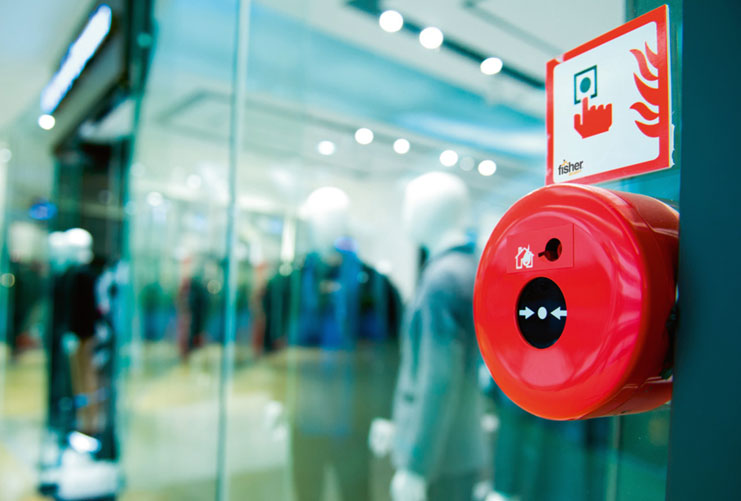
Protecting Server Rooms and Data Rooms: Protecting More Than Equipment
A server room may occupy only a small part of a building, but its importance to the organization can be enormous. Servers, network infrastructure, communications systems and stored data can support almost every part of a company's operation. A relatively small fire in that room can therefore cause consequences far greater than the physical value of the equipment that is damaged.
In many cases, the larger loss is business interruption.
This article explains how we at Java Fire Protection protect server rooms, data rooms and other critical technology spaces: what we assess, how detection and suppression work together, how to choose between clean agents, and why the room has to be reviewed as it changes. It is written for IT, data-centre and facilities managers, banks and other organizations in Lebanon whose operations depend on these rooms. Where it helps, we point to the references behind our practice:
- NFPA 75, Standard for the Fire Protection of Information Technology Equipment (2024);
- NFPA 76, Standard for the Fire Protection of Telecommunications Facilities (2024);
- NFPA 72, National Fire Alarm and Signaling Code (2025);
- NFPA 2001, Standard on Clean Agent Fire Extinguishing Systems (2025);
- Lebanon's public safety decree.
Our view in brief
- We start from what the room means to the organization, not only from what is inside it.
- We put early detection first.
- We design clean agent systems as complete systems: enclosure, discharge, alarms, controls, interfaces and procedures.
- We keep personnel safety at the centre of the design.
- We review the protection whenever the room changes.
Why do we protect a server room from two directions?
Because a server-room fire is both a fire-protection problem and a business-continuity problem. This is why we approach server-room and data-room protection from two directions at the same time: fire protection and business continuity. The first step is to understand not only what is inside the room, but what that room means to the organization. When we survey a room, we ask:
| Question | Why it matters |
|---|---|
| What equipment is present? | It determines the fuel load, the heat output and what the protection must preserve. |
| How critical is it? | A core banking or broadcast room justifies a different level of protection from a small network cabinet. |
| Is the room continuously occupied? | It affects the choice of agent, alarms and evacuation arrangements. |
| What are the electrical risks? | Batteries, UPS units and power distribution are frequent ignition sources. |
| How is the cooling arranged? | High airflow dilutes smoke and affects both detection and how long the agent stays in the room. |
| Are there raised floors, concealed spaces or cable penetrations? | Each one is a space to detect and protect, and a possible leak for the agent. |
| What happens to the business if that room becomes unavailable? | This is the question that decides how far the protection should go. |
Why does early detection matter so much?
Because in an electronic environment, the damage starts long before there are flames. Early detection is particularly important in these environments. Where high-value and sensitive electronic equipment is involved, identifying a developing condition before it becomes a large fire can significantly reduce the consequences. Depending on the facility and the risk assessment, the strategy may include suitable detection together with an appropriate suppression solution.
In many critical rooms, this means aspirating smoke detection. It draws air continuously through a network of sampling pipes to a sensitive detector, and it can pick up an overheating cable or component at a very early stage, even in high airflow. NFPA 76, the standard for telecommunications facilities, defines very early warning (VEWFD) and early warning (EWFD) detection levels, which are widely used as the performance benchmark for these systems. NFPA 72 sets the installation and testing requirements for air-sampling detectors. Their staged alarms let staff investigate and act before the suppression system needs to discharge.
Clean agent, sprinklers, or both?
It depends on the building, and in a sprinklered building the answer is usually both. Under NFPA 75, an IT equipment room in a sprinklered building generally has to be sprinklered as well. A clean agent system can be added to protect the equipment and keep it running, but it does not replace the sprinklers. Only in a building without sprinklers does NFPA 75 allow sprinklers, a clean agent system, or both.
In sprinklered buildings, critical rooms are commonly protected in two layers:
- A pre-action sprinkler system. It keeps the pipes dry until the detection system operates, and in a double-interlock design until a sprinkler also opens.
- A clean agent system. It is triggered at an earlier stage and leaves no residue.
A clean agent system extinguishes a fire in an enclosed room without water and without leaving residue on the equipment. It works only if the room can hold the agent long enough, which is why the enclosure is as important as the cylinders.
Which clean agent: FM-200, FK-5-1-12 or inert gas?
Each can be the right choice. The decision depends on the room, its occupancy, the space for cylinders and the future of the agent. The main options, all covered by NFPA 2001:
| HFC-227ea (FM-200) | FK-5-1-12 (formerly sold as Novec 1230) | Inert gases (IG-541, IG-55, IG-01, IG-100) | |
|---|---|---|---|
| What it is | A hydrofluorocarbon (HFC) | A fluorinated ketone | Naturally occurring gases: nitrogen, argon, sometimes with CO₂ |
| How it works | Mainly absorbs heat, with some chemical interruption of the flame | Mainly absorbs heat | Lowers the oxygen level below what a fire needs |
| Discharge time | 10 seconds or less | 10 seconds or less | 60 seconds; up to 120 seconds permitted for Class A and C hazards such as IT rooms |
| Storage | Liquid, compact cylinders | Liquid, compact cylinders | High-pressure gas: more cylinders and more space |
| Occupied rooms | Designed up to its safe exposure limit (NOAEL) of 9%, close to its typical design concentration | Typical design concentration about half its 10% NOAEL: the widest safety margin of the gaseous agents | Used within safe oxygen limits |
| Environmental position | High global warming potential. HFC production and consumption, including imports, are being phased down under the Kigali Amendment, which Lebanon ratified in 2020. A PFAS under the broad OECD definition. | Very low global warming potential. 3M announced it would stop producing Novec 1230 by the end of 2025, and FK-5-1-12 is made by other manufacturers. Like HFC-227ea, a PFAS under the broad OECD definition, within the scope of the EU's proposed PFAS restriction. | No global warming potential, and not PFAS |
| Room requirements | Tight enclosure; peak-pressure check, with relief venting where needed | Tight enclosure; peak-pressure check, with relief venting where needed | Tight enclosure and pressure relief venting |
FM-200 is not banned, and existing systems can continue to be maintained and recharged. For a new system, we now look at the long-term availability, cost and regulatory outlook of the agent as part of the decision, not only the price of the installation.
What makes a clean agent system work, beyond cylinders and pipework?
The enclosure, the discharge, the alarms, the control logic, the interfaces and the procedures, all working together. Where clean-agent suppression is appropriate, the protection cannot be reduced to simply installing cylinders and pipework. The room enclosure, discharge arrangement, alarms, control logic, manual release, abort functions where applicable, interfaces with other systems and the operating procedures all need to work together. Personnel safety also has to remain central to the design.
- The enclosure. We test the room with a door fan integrity test, which pressurises and depressurises the room to measure its leakage. Using the method in NFPA 2001, the results predict how long the room will hold the agent. The standard requires at least 85% of the minimum design concentration to remain at the height of the highest protected equipment for 10 minutes, or longer if trained responders need more time. Where the room leaks, we seal it before the system is relied on.
- The discharge arrangement. Agent quantity, nozzle positions and pipe sizes come from the manufacturer's listed calculation method, so that the agent reaches the design concentration everywhere in the room, including raised floors and ceiling voids where they are protected. Under NFPA 75, where the room above a raised floor is protected by clean agent, the space below the floor must be protected at the same time.
- Alarms. A pre-discharge alarm and time delay give occupants time to leave before the agent is released.
- Control logic. Discharge is usually triggered only when two detectors confirm a fire, to avoid an unwanted release.
- Manual release and abort functions. A manual release allows staff to discharge the system. Where an abort switch is used, it holds the countdown only while it is kept pressed. It cannot stop a manual release, and it is never a way to disable the system.
- Interfaces. Before discharge, the air conditioning shuts down and dampers close, so the agent is not exhausted from the room. Where required, power to the equipment is also shut down.
- Operating procedures. Signage, staff training, a lock-out arrangement for maintenance, and clear rules for who does what when the alarm sounds.
What happens when the room changes?
The protection must be reviewed, because the room it was designed for may no longer exist. Another important point is that server rooms rarely remain unchanged. Equipment is added, cooling systems are modified, new cable penetrations are created, doors are replaced and the integrity of the enclosure can change. A system that was suitable when originally commissioned may therefore need to be reviewed as the room evolves.
The changes that most often affect protection:
- new cable or pipe penetrations left unsealed;
- a new door, door closer or door seal;
- new cooling units that change the airflow;
- racks added or rearranged, changing the room volume or the detection coverage;
- hot- or cold-aisle containment added, which must not block the agent or the sprinklers;
- a false ceiling or raised floor opened up or extended.
NFPA 2001 sets the maintenance schedule:
- Monthly: a visual inspection by the owner.
- At least every six months: the agent quantity and pressure in the containers are checked. A halocarbon container that has lost more than 5% of its agent, or more than 10% of its pressure (adjusted for temperature), is refilled or replaced.
- At least every year: the system is inspected and tested, and the enclosure is inspected for changes.
When the enclosure has changed, we repeat the integrity test.
What does Lebanese law require?
Lebanese law sets the framework, and the standards a project adopts under it (in our practice, NFPA) provide the technical detail. Lebanon's public safety decree is Decree No. 14293 of 2005, as amended in full by Decree No. 7964 of 2012:
- One standard per subject. Article 1(10) applies Lebanese standards, or, where none exist, those adopted in the EU, the US or Canada. Article 3 requires a single source per safety subject. We design critical-room protection to NFPA 75, NFPA 76, NFPA 72 and NFPA 2001, rather than mixing US and European requirements.
- Maintenance. Article 4(4) makes the owner, or the owners' association, responsible for the periodic maintenance of the building and its equipment.
Banks, insurers and international groups often add their own requirements on top of this framework.
How have we protected critical rooms?
Our work in this area includes:
- The main data centre of one of Lebanon's largest banking groups. We designed the protection from the mechanical drawings and final rack layouts. The design used aspirating smoke detection and clean agent suppression across six zones on three protection levels. We carried out a door fan integrity test before installation, to confirm that the rooms could retain the agent and to size the sealing and pressure relief works.
- The production and standby data centres of a leading commercial bank. We applied the same protection standard to both sites, so that a failover never moves operations into a less protected room.
- The broadcast operation of a global news network in Beirut. We protected the server rooms with FM-200, and added clean agent units directly inside electrical boards and panels.
- Two data centres of a leading ICT infrastructure provider. One specification covered both sites: one spare-parts list and one maintenance regime.
Protecting the organization's ability to operate
At Java, our objective is not simply to protect a collection of servers. It is to understand what those servers mean to the organization. Protecting critical technology is ultimately about protecting the organization's ability to continue operating.
Building a new server room, changing an existing one, or unsure whether your system still fits the room? Speak with our team about a critical-room survey.
Frequently asked questions
FK-5-1-12 or FM-200: which clean agent should I choose?
Both are effective, both need a tight room, and both discharge in 10 seconds or less. FK-5-1-12 has a very low global warming potential and the widest safety margin for occupied rooms. FM-200 is a hydrofluorocarbon whose supply is being phased down. Both are fluorinated agents that fall under the broad OECD definition of PFAS, which the EU is considering restricting. An inert gas system avoids this question, where there is space for the cylinders. For a new system, we weigh the room, its occupancy and the long-term outlook for the agent.
Is FM-200 safe for people in an occupied room?
Yes, when the system is designed within the NFPA 2001 limits for occupied spaces and the room is evacuated during the pre-discharge alarm. For HFC-227ea, the limit is its 9% NOAEL, or up to 10.5% only where exposure is limited to five minutes. Staff should still leave when the alarm sounds, because both the fire and the agent's breakdown in the flame produce harmful products such as hydrogen fluoride.
How often should an FM-200 system be maintained?
The owner should inspect it visually every month. At least every six months, the agent quantity and container pressure are checked. At least once a year, the whole system is inspected and tested, including detection, alarms, releasing devices and interfaces, and the enclosure is inspected. We also repeat the door fan integrity test when the room changes.
Our FM-200 system is 12 years old. Should we repair it or replace it?
It depends on three things:
- its condition;
- whether the system manufacturer still supports that model with listed parts and agent;
- whether the room still matches the original design.
Before a discharged system can be refilled, its containers may need requalification if their last test is more than five years old. Flexible hoses are pressure-tested every five years. We assess the system, the room and the supply of the agent, then recommend repair, refurbishment or replacement.
What is a door fan integrity test for a server room?
It is a test that uses a fan fitted in the doorway to pressurise and depressurise the room and measure its leakage. The results predict how long the room will hold the clean agent at the required concentration. A room that leaks too much will lose the agent before the fire is fully extinguished.
How does a clean agent system shut down the air conditioning and close dampers?
The fire alarm and releasing control panel sends signals, through relays or interface modules, to the air conditioning controls and to motorised dampers. On alarm, they shut down the air handling units and close the dampers before discharge, so the agent stays in the room. We test these interfaces at commissioning and at every annual service, and we check that fans stop and dampers close within the time delay.
What replaces Novec 1230 now that 3M has stopped producing it?
Novec 1230 was 3M's brand of FK-5-1-12. 3M announced that it would stop producing it by the end of 2025, but FK-5-1-12 is still made by other manufacturers and supplied for listed systems. An existing system should be recharged only with agent its manufacturer approves for that listing. For new installations, the choice is between FK-5-1-12, other listed agents and inert gas, which avoids fluorinated agents altogether.
Is FM-200 being phased out?
FM-200 (HFC-227ea) is a hydrofluorocarbon. Under the Kigali Amendment to the Montreal Protocol, which Lebanon ratified in 2020, HFC production and consumption, including imports, are being cut step by step. The EU restricts placing new fire protection equipment containing HFCs on the market where suitable alternatives exist, and in the United States, new rules are phasing in the use of recycled HFCs for new and serviced fire suppression systems. FM-200 is not banned, and existing systems can still be maintained and recharged, but supply and cost are likely to tighten.
Small server rooms in bank branches: gas suppression or detection only?
It depends on what the room supports and what would happen if it were lost. For many branch rooms, the following are proportionate:
- early detection connected to the building alarm;
- a CO₂ or clean agent extinguisher suitable for electrical equipment;
- good housekeeping.
If the building is sprinklered, an IT equipment room still needs its sprinklers. Where a room carries critical services, or cannot be quickly replaced, a clean agent system or a local application unit inside the cabinet can be justified.
The company that installed our FM-200 system has closed. Who can service and recharge it?
A competent contractor can take over if three things hold:
- the system's manufacturer is identified, since the listing belongs to the manufacturer, not the installer;
- the design documentation is available or can be reconstructed;
- listed parts and agent can still be sourced.
We start by surveying the system and the room, then confirm what is needed to bring it back under a proper maintenance programme.
References
- NFPA 75, Standard for the Fire Protection of Information Technology Equipment, 2024 edition.
- NFPA 76, Standard for the Fire Protection of Telecommunications Facilities, 2024 edition.
- NFPA 72, National Fire Alarm and Signaling Code, 2025 edition.
- NFPA 2001, Standard on Clean Agent Fire Extinguishing Systems, 2025 edition.
- Kigali Amendment to the Montreal Protocol on Substances that Deplete the Ozone Layer (2016); ratified by Lebanon in 2020.
- Regulation (EU) 2024/573 on fluorinated greenhouse gases.
- Decree No. 14293 of 11 March 2005 on public safety in buildings and facilities, as amended in full by Decree No. 7964 of 7 April 2012 (Lebanon).